

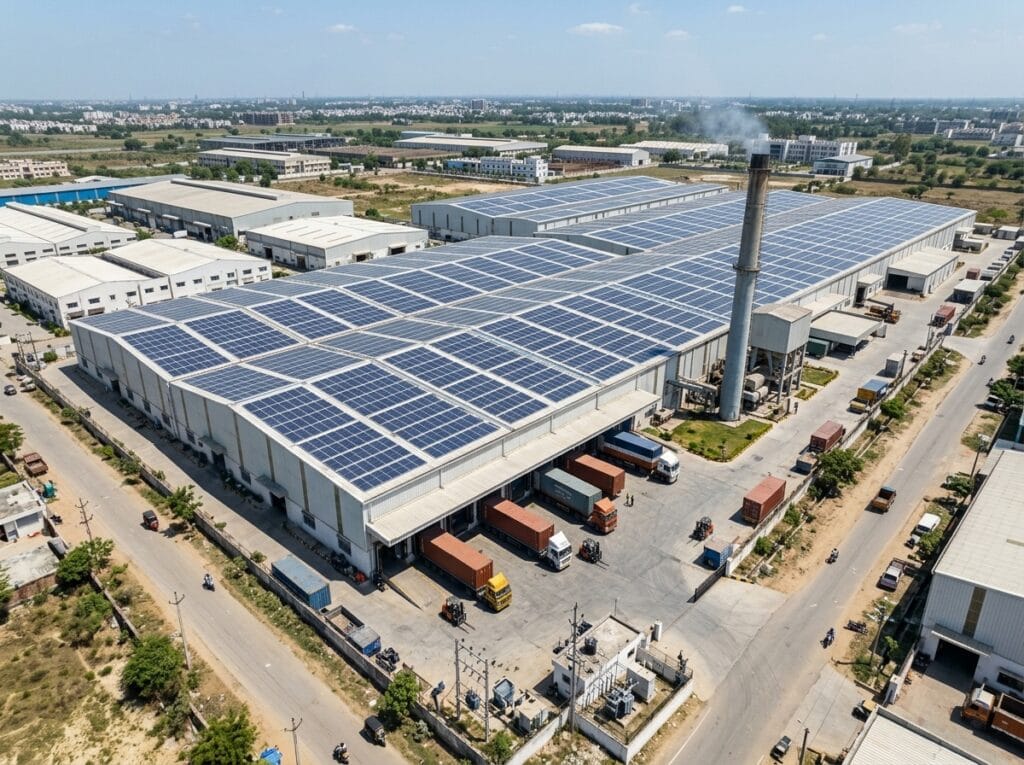
Solar System for Factory in Lucknow (2026): Complete Guide for Manufacturing Units, Warehouses & Industrial Plants
Quick Answer — Factory Solar in Lucknow 2026
A solar system for a factory in Lucknow costs ₹40,000–₹55,000 per kW fully installed. Most Lucknow factories with a monthly bill of ₹1–3 lakh need a 50–100kW system costing ₹20–55 lakh. During solar hours (9 AM–4 PM), the system can cover 80–100% of factory load, saving ₹48,000–₹1.2 lakh per month. With 40% Accelerated Depreciation, payback is typically 3–4 years — after which the factory generates free power for 20+ years.
For factory and industrial unit owners in Lucknow, electricity is not just an operational cost — it is often the single biggest variable expense after raw materials. With UPPCL commercial and industrial tariffs in Lucknow ranging from ₹6.50 to ₹9.50 per unit, a 100kW factory draws electricity worth ₹72,000–₹1,08,000 every month from the grid. A well-designed factory solar system can eliminate 70–100% of that daytime cost permanently. This guide explains everything specific to factory solar in Lucknow — system sizing, technical requirements, installation process, and real ROI numbers.
1. How to Size a Solar System for Your Lucknow Factory
Factory solar sizing requires a more careful analysis than residential — because industrial loads are more variable and shift-based. Here’s the methodology we use for every factory project in Lucknow:
| Monthly Electricity Bill | Approx. Monthly Units | Recommended System | Est. System Cost | Monthly Saving |
|---|---|---|---|---|
| ₹50,000–₹1,00,000 | 5,000–12,500 units | 25–50kW | ₹10L–₹27.5L | ₹24,000–₹48,000 |
| ₹1,00,000–₹3,00,000 | 12,500–37,500 units | 50–100kWCOMMON | ₹20L–₹55L | ₹48,000–₹96,000 |
| ₹3,00,000–₹10,00,000 | 37,500–1,25,000 units | 100–300kW | ₹40L–₹1.65Cr | ₹96K–₹3.6L |
| ₹10,00,000+ | 1,25,000+ units | 300kW–1MW+ | ₹1.65Cr–₹5.5Cr+ | ₹3.6L–₹12L+ |
2. Factory Solar System Price — Lucknow 2026
| System Size | Roof Area | Panel Count (540W) | Total Installed Cost | After 40% AD Benefit (30% tax) |
|---|---|---|---|---|
| 25kW | 2,000–2,500 sq ft | 46–48 panels | ₹10L–₹13.75L | ~₹8.8L–₹12.1L |
| 50kWPOPULAR | 4,000–4,500 sq ft | 92–96 panels | ₹20L–₹27.5L | ~₹17.6L–₹24.2L |
| 100kWBEST ROI | 8,000–9,000 sq ft | 185–190 panels | ₹40L–₹55L | ~₹35.2L–₹48.4L |
| 200kW | 16,000–18,000 sq ft | 370–380 panels | ₹80L–₹1.1Cr | ~₹70.4L–₹96.8L |
| 500kW | 40,000–45,000 sq ft | 925–950 panels | ₹2Cr–₹2.75Cr | ~₹1.76Cr–₹2.42Cr |
3. Technical Requirements for Factory Solar Systems in Lucknow
Factory solar systems have significantly more technical requirements than residential installations. Here’s what changes at the industrial level:
Inverter Selection for Factories
| System Size | Inverter Type | Why |
|---|---|---|
| Up to 50kW | String inverters (multiple units) | Simpler, lower cost, modular — good for factories with varied roof sections |
| 50kW–200kW | Central inverter or multi-string | Better efficiency for large uniform arrays, central monitoring, lower per-kW cost |
| 200kW+ | Central inverter + SCADA monitoring | Real-time generation monitoring, grid protection relay, DISCOM compliance |
Roof Structure Assessment — Critical for Factories
Many Lucknow factories have metal sheet or asbestos roofing (GCI/ACC sheets). Solar can absolutely be installed on these — but requires a different mounting approach than flat RCC terraces:
- Metal sheet roofs: Use colour-coated steel Z/L-purlins clamped to existing roof ribs — no drilling through the sheet
- Asbestos (ACC) roofs: Require structural assessment first — old/brittle asbestos may need reinforcement before panel load
- RCC terraces: Standard ballasted or drilled mounting — most straightforward and lowest cost
- Multi-level roofs: Each section sized independently based on shade analysis — micro-inverters or power optimisers may be needed
4. Factory Solar Installation Process in Lucknow
Detailed Site Survey & Load Analysis
Our engineer visits your factory, reviews 12 months of electricity bills, analyses shift patterns, maps the roof (area, type, obstacles, shadow sources), and assesses the existing electrical infrastructure (DB room, main incoming feeder, earthing quality).
System Design & Detailed Engineering
We prepare a complete system design — panel layout on scaled roof drawing, single-line diagram, inverter placement, cable route plan, earthing design, lightning protection layout, and shadow analysis report. This is what separates professional industrial installers from residential vendors doing commercial work.
Material Procurement & Quality Check
ALMM-listed commercial-grade panels, commercial string or central inverter, heavy-duty GI/aluminium mounting structure rated for Lucknow’s wind zone (Wind Zone 4, 39 m/s basic wind speed), UV-rated DC cables, AC panel, protection relays, and SCADA/monitoring system for large installations.
Physical Installation
Our certified factory installation team installs the mounting structure (without disturbing factory operations wherever possible), mounts panels, runs DC trunk cables from roof to inverter room, installs inverter(s) and AC panel, connects to factory distribution board through dedicated solar feeder, and commissions the full system with live generation testing.
UPPCL Industrial Net Metering Application
We prepare and submit the full UPPCL application — load flow study, protection coordination report, single-line diagram, inverter certificate, and application form — to your UPPCL division office. For HT connections, we coordinate with the DISCOM at the Circle/Zone level as required.
5. Accelerated Depreciation & Tax Benefits for Factory Solar in Lucknow
This is the most underutilised financial tool available to Lucknow factory owners. Under Section 32 of the Income Tax Act, solar power plants qualify for Accelerated Depreciation:
| Parameter | 100kW System Example |
|---|---|
| System Cost | ₹47,50,000 |
| AD Rate (Year 1) | 40% |
| Year 1 Depreciation Claim | ₹19,00,000 |
| Tax Saved at 30% corporate tax | ₹5,70,000 |
| Tax Saved at 25% corporate tax | ₹4,75,000 |
| Effective Cost After AD Benefit | ₹41,80,000–₹42,75,000 |
| Year 1 Energy Saving (100kW) | ₹11.52L–₹14.4L |
| Total Year 1 Benefit (AD + Energy) | ₹16.27L–₹20.1L |
⚙️ Book a Free Factory Solar Assessment in Lucknow
We analyse your electricity bills, load pattern, roof area, and give you exact system design, savings projection, and payback calculation — free, no obligation.
6. Can Solar Run Heavy Factory Machinery in Lucknow?
This is the most common question from factory owners considering solar. The answer is yes — but with an important nuance:
| Load Type | Solar Compatible? | Notes |
|---|---|---|
| Motors (up to 50HP) | ✅ Yes | Solar handles steady-state motor loads well. Starting surge drawn from grid |
| Compressors (air/refrigeration) | ✅ Yes | Compressor cycling load handled by on-grid system seamlessly |
| Conveyors & assembly lines | ✅ Yes | Steady linear loads — ideal for solar offset |
| Welding equipment | ✅ Partial | High spike loads during arc start — grid handles spike, solar handles base |
| CNC machines & lathes | ✅ Yes | Sensitive equipment needs clean sine wave — grid-tied solar provides this |
| Induction furnaces | ✅ Partial | Very high load — solar contributes but cannot fully offset |
| Night shift operations | ❌ Grid only | Solar doesn’t generate at night — grid or battery storage needed |
7. Common Mistakes in Factory Solar Projects in Lucknow
- Sizing based on total consumption instead of daytime consumption — If your factory runs 3 shifts but most solar generation happens during shift 1, your daytime consumption is what matters. Oversizing for total consumption wastes capital.
- Skipping the structural roof assessment — Metal sheet and old RCC roofs need structural verification before adding 5–8 kg/sq ft of panel load. This step is non-negotiable for safety.
- Using residential-grade DC cables for industrial systems — Factory rooftops run hotter than residential, and industrial DC cable runs are longer. Residential 4mm² cable on a 100kW factory system causes voltage drop and fire risk. Always specify 6mm² UV-rated DC cables.
- No SCADA monitoring on systems above 50kW — Without real-time monitoring, underperforming strings go undetected for months, silently costing you energy savings. All factory systems above 50kW should have cloud-based generation monitoring.
- Choosing a residential solar company for an industrial project — A vendor who installs 3kW home systems is not equipped to design protection relays, HT metering schemes, or industrial-grade mounting structures for a 200kW factory. Commercial solar requires different expertise.
