
Rooftop Solar for Apartments in Lucknow (2026): A Guide for RWAs & Flat Owners
Quick Summary — Rooftop Solar for Apartments in Lucknow
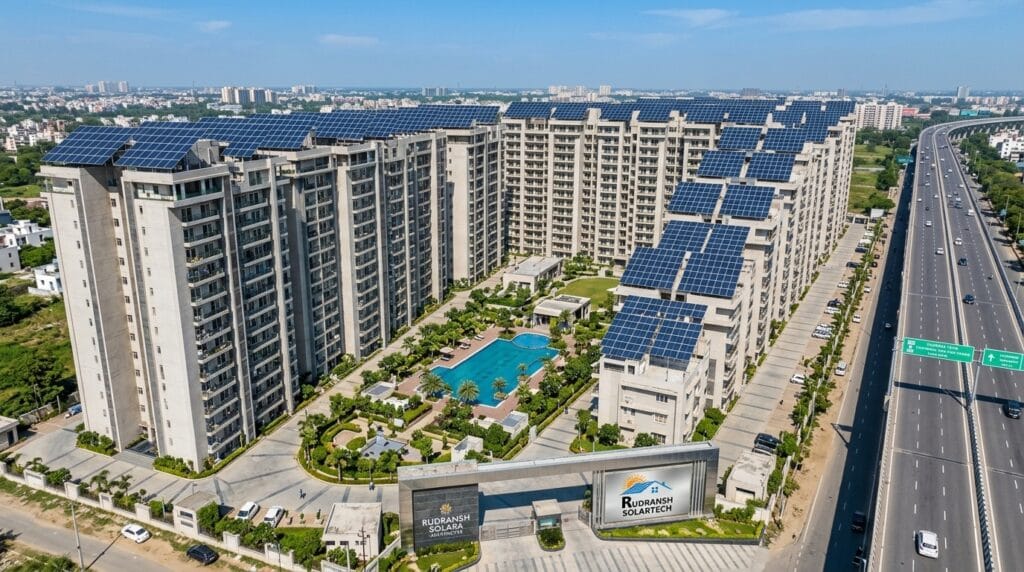
Transitioning to rooftop solar for apartments in Lucknow is a highly effective way for Resident Welfare Associations (RWAs) to reduce high maintenance bills. A common solar system, typically sized between 15kW and 50kW, offsets common area utility costs (elevators, basement lighting, water pumps) by exporting power under UPPCL’s society net billing guidelines. An average 25kW society system costs ₹11–13.5 lakh, yielding annual electricity savings of **₹2.4 to ₹3.0 lakh** and paying for itself in under **4 years**. According to Lucknow Development Authority (LDA) regulations, rooftop solar is mandatory for all new multi-family high-rise maps.
Apartment living is growing rapidly in Lucknow, with major high-rise complexes expanding along Shaheed Path, Sultanpur Road, and Gomti Nagar Extension. However, managing common area maintenance charges is a frequent source of friction between Resident Welfare Associations (RWAs) and flat owners. Running elevators, pumping water to overhead tanks, and lighting large basements and parking zones consumes massive amounts of electricity under LESA’s high-tariff common connection category. Installing rooftop solar for apartments in Lucknow offers a strategic solution, turning empty concrete roofs into generators that reduce monthly maintenance costs by up to 60%. This guide covers legal space sharing, UPPCL net billing guidelines for housing societies, installation pricing, and the steps to get RWA approvals.
1. LDA Solar Regulations for High-Rise Group Housing
The Lucknow Development Authority (LDA) has taken a proactive stance on urban renewable energy adoption. Under the current building code, all new high-rise complexes, multi-family group housing societies, and commercial-residential developments are legally required to integrate a rooftop solar for apartments in Lucknow setup in their building plans.
Before issuing completion certificates or approving occupancy clearances, LDA inspectors verify that a minimum percentage of the building’s total connected load is supported by solar. For most residential apartments, this mandate requires installing a capacity equivalent to **10% to 15% of the total common connected load**.
2. RWA Common Connection vs. Individual Flat Installations
When considering solar options in an apartment complex, there are two primary installation pathways:
Common Area System (RWA-led)
The system is installed on the common roof and connected to the society’s common area electricity meter. It offsets power costs for lifts, pumps, and parking lights, benefiting all flat owners by reducing maintenance bills.
Individual Flat System
A flat owner installs a private system on a designated portion of the common roof. The power is routed directly down to their individual flat meter. This requires a formal NOC from the RWA and other co-owners.
Because rooftop space is shared in multi-floor apartments, the common area system is the most efficient approach. It optimizes the available roof space and benefits everyone equally. To learn about residential financing options that can cover these collective investments, review our guide on solar panel loan options in Lucknow.
3. UPPCL Net Metering and Billing Rules for Societies
Grid integration for apartment societies in Lucknow is managed by LESA/UPPCL. The billing structure depends on the society’s connection type:
- Common Area Metering: The solar system is integrated with the common area tariff connection (typically LMV-2 or high-slab LMV-1). The exported solar units are subtracted from the total common area units consumed, resulting in significant savings.
- Net Billing Credit: If the society exports surplus power during holidays or cooler months, the credit is settled annually at the UPPCL APPC rate (average power purchase cost of ₹3 to ₹4 per unit).
To understand the regulatory guidelines for grid connections and check billing settlement windows, read our guide on UPPCL commercial and residential net metering rules in UP.
4. The Step-by-Step RWA Approval Checklist
Executing a collective solar project in an apartment complex requires clear consensus. RWAs should follow this structured process to ensure smooth implementation:
- RWA Resolution: Present the proposal at the General Body Meeting (GBM) and pass a formal resolution with a simple majority of co-owners.
- Feasibility Assessment: Conduct a physical roof load-bearing test and shadow analysis to verify that the rooftop can safely support the static weight of panels and wind loads.
- NOC Documentation: Secure signed NOCs from top-floor residents to ensure they are comfortable with structure installation above their flats.
- UPPCL Approvals: Submit the feasibility request under the society’s name on the national portal, coordinating with local LESA engineers.
To learn about Domestic Content Requirement (DCR) rules that apply to collective residential projects, explore our guide on DCR vs Non-DCR solar panels in Lucknow.
5. Installation Costs and Payback for Lucknow Apartments
Sizing for housing societies benefits from bulk discounts, reducing the per-kW installation cost compared to individual homes. Below is the verified cost breakdown for apartment complexes for 2026:
| System Capacity | Typical Society Sizing | Gross Cost Range | Estimated Monthly Savings | Simple Payback Period |
|---|---|---|---|---|
| 10 kWp | Small apartment (10–15 flats) | ₹4,80,000 – ₹5,50,000 | ₹9,000 – ₹11,000 | 4.5 – 5.0 Years |
| 25 kWp | Medium apartment (20–40 flats) | ₹11,00,000 – ₹13,50,000 | ₹20,000 – ₹25,000 | 3.8 – 4.5 Years |
| 50 kWp | Large society (50–100 flats) | ₹20,50,000 – ₹23,50,000 | ₹40,000 – ₹50,000 | 3.5 – 4.0 Years |
| 100 kWp | Premium township / clubhouses | ₹38,00,000 – ₹42,00,000 | ₹85,000 – ₹1,00,000 | 3.2 – 3.8 Years |
To run custom payback models based on your society’s actual electricity consumption, use our interactive solar ROI savings calculator. This tool maps out exact generation curves and matches them against UPPCL’s high commercial and domestic common area tariff slabs.
6. How to Request a Society Proposal
Implementing solar in a housing society requires professional engineering, wind-load assessments, and clear presentation decks to convince RWA members. At Rudransh Solartech, we support RWAs by conducting free site assessments and providing detailed financial viability proposals.
To book a site survey and get a customized proposal for your apartment society, click the link to visit our residential solar page. For larger commercial installations or institutional properties, you can explore our commercial solar page.
🏢 Reduce Your Society Maintenance Bills with Rooftop Solar
Schedule a free physical site visit, roof load assessment, and customized RWA financial proposal.
📍 Active Apartment Solar Service Areas in Lucknow
We provide full installation and maintenance services for apartment societies across all major growth corridors:
