
Monocrystalline vs Polycrystalline Solar Panels in Lucknow (2026): The Ultimate Buyer’s Guide
Quick Answer — Monocrystalline vs Polycrystalline in Lucknow
In 2026, Polycrystalline panels are essentially obsolete for residential use. Polycrystalline panels are cheaper upfront (₹20–25/watt) but have lower efficiency (16–18%) and perform very poorly in Lucknow’s extreme summer heat. Monocrystalline panels cost ₹28–35/watt but offer higher efficiency (20–23%), perform much better under high heat, require 30% less roof space, and are the industry-standard recommendation for securing solar subsidies today.
If you’re beginning your solar journey in Lucknow, you’ll immediately face the choice of solar cell technology: Monocrystalline or Polycrystalline. Local contractors often push polycrystalline panels as a budget option. But does saving a few thousand rupees upfront justify lower generation for the next 25 years? In Lucknow’s climate, where temperature peaks degrade solar performance, choosing the wrong technology can decimate your ROI. This guide compares them head-to-head.
1. Specification Table — Monocrystalline vs Polycrystalline
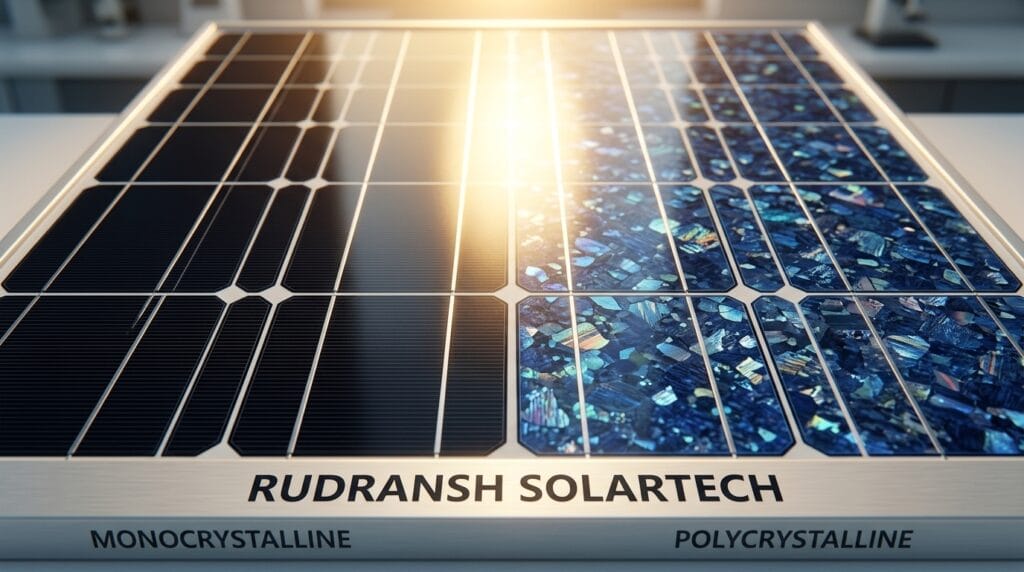
The core differences between these two solar panel types are rooted in their cell manufacturing processes. Monocrystalline uses single-crystal silicon structures, whereas polycrystalline uses cast multi-crystal blocks. Below is their direct technical comparison:
| Technical Feature | Monocrystalline Solar Panels | Polycrystalline Solar Panels |
|---|---|---|
| Cell Structure | Single pure silicon crystal | Multiple melted silicon fragments |
| Efficiency Range | 20% – 23% HIGH | 15% – 18% LOW |
| Physical Appearance | Uniform black, rounded edges | Blue speckled, square edges |
| Temperature Performance | Excellent (Low power drop in heat) | Poor (High power drop in heat) |
| Roof Space Required (per kW) | ~60–70 sq ft | ~90–100 sq ft |
| Lifespan & Degradation | 25-30 years (Slower decay) | 20-25 years (Faster decay) |
2. Lucknow Summer Performance: The Heat Coefficient Factor
Solar panels are tested at a standard temperature of 25°C. For every degree above this, their output drops. This rate is called the temperature coefficient:
- Monocrystalline panels have a temperature coefficient of roughly -0.34% to -0.37% per °C.
- Polycrystalline panels have a higher temperature coefficient of -0.40% to -0.45% per °C.
During a typical Lucknow summer afternoon in May/June, rooftop temperatures easily touch 65°C (40°C above standard test conditions). Under these conditions, a polycrystalline panel loses nearly 18% of its rated capacity to heat alone, whereas a high-quality monocrystalline panel retains far higher generation efficiency.
3. Space Savings: How Much Roof Area Do You Need?
Monocrystalline panels generate more watts per square foot. This is vital for residential terraces in Lucknow, where space is needed for water tanks, terrace gardens, or general utility:
📐 Rooftop Space Required for a 3kW System in Lucknow
4. Subsidy Rules in UP: Can You Use Poly Panels?
Technically, the PM Surya Ghar subsidy rules in Uttar Pradesh do not explicitly ban polycrystalline modules. However, to claim the subsidy, panels must be registered in the **ALMM list** and be **DCR-compliant**.
5. Estimated Price Difference for a 3kW System
Let’s weigh the financial numbers for a typical 3kW installation in Lucknow. Even though polycrystalline panels have a lower initial price tag, the net cost after accounting for the government subsidy proves that monocrystalline is far more cost-effective:
📊 Cost Breakdown Comparison (3kW System – Lucknow 2026)
🏠 Future-Proof Your Home with Monocrystalline Solar
Do not buy obsolete technology. Speak with our experts to design a high-efficiency Monocrystalline or TOPCon solar system today.
📍 Monocrystalline Projects in Lucknow
We install and maintain high-efficiency monocrystalline solar systems in all zones of Lucknow:
