
Industrial Rooftop Solar System Price in UP (2026): Costs, ROI & Subsidies
Quick Answer — Industrial Rooftop Solar System Price in UP
In 2026, the average industrial rooftop solar system price in UP ranges from ₹35,000 to ₹48,000 per kWp for turnkey grid-connected installations. A 50kW factory system costs ₹20–25 lakh, a 100kW plant costs ₹38–45 lakh, and a large-scale 500kW system costs ₹1.8–2.1 crore. These pricing benchmarks include standard components, structural reinforcement, engineering, and UPPCL net metering integration. While direct government subsidies are not available, businesses can utilize tax incentives like 40% Accelerated Depreciation and 18% GST Input Credit to recover up to 35% of the total cost in Year 1.
If you are researching the industrial rooftop solar system price in UP, you are likely looking for a practical way to manage rising operational costs. Manufacturing plants, textile mills, cold storage units, and packaging facilities consume large amounts of electricity. Because grid tariffs for industrial connections (LMV-6 and HV categories) are high, transitioning to solar can significantly improve your bottom line. Generating power on-site allows you to replace grid electricity that costs ₹7.50 to ₹9.50 per unit with solar energy, which pays for itself in just a few years. This guide provides a detailed breakdown of the industrial rooftop solar system price in UP, highlighting component differences, structural considerations, tax benefits, and ROI timelines.
1. Industrial Rooftop Solar System Price in UP — Capacity Benchmarks
The total investment required for an industrial solar plant is determined by the size of the installation. Larger systems benefit from economies of scale, resulting in a lower per-kW rate. For example, a 500kW plant is more cost-effective per kilowatt than a 50kW plant. This makes solar a highly attractive option for large-scale operations.
When analyzing the industrial rooftop solar system price in UP, it is helpful to look at capacity-specific benchmarks. Below is a detailed cost breakdown based on system sizes commonly used in the state’s industrial areas:
| Plant Capacity | Typical Application | Annual Generation | Price Range (Turnkey 2026) | Estimated Payback Period |
|---|---|---|---|---|
| 50 kWp | Medium Printing Press, Rice Mill | 72,000 kWh | ₹20,00,000 – ₹25,00,000 | 3.8 – 4.5 Years |
| 100 kWp | Cold Storage, Automotive Ancillary | 1,45,000 kWh | ₹38,00,000 – ₹45,00,000BEST FOR C&I | 3.2 – 3.8 Years |
| 250 kWp | Textile Mill, Chemical Unit | 3,62,000 kWh | ₹90,00,000 – ₹1.05 Crore | 3.0 – 3.5 Years |
| 500 kWp | Large Manufacturing Facility, IT Park | 7,25,000 kWh | ₹1.80 Crore – ₹2.10 CroreOPTIMUM ROI | 2.8 – 3.3 Years |
| 1 MWp (1000 kW) | Cement Plant, Heavy Machinery Hub | 14,50,000 kWh | ₹3.40 Crore – ₹3.90 Crore | 2.6 – 3.2 Years |
For a 100kW plant, the industrial rooftop solar system price in UP is typically ₹38 to ₹45 lakh, depending on the site conditions. This capacity is particularly popular as it fits the sanctioned load profile of many medium-sized enterprises in regions like Lucknow, Kanpur, and Ghaziabad. At a larger scale, the 500kW industrial rooftop solar system price in UP becomes even more competitive, often dropping below ₹38,000 per kW due to bulk purchasing of Tier-1 components.
2. How Roof Types and Engineering Impact the Cost
The type of roof on your facility has a direct impact on the overall cost. Industrial sheds generally use metal sheets, which require different mounting structures compared to concrete roofs. For example, concrete roofs require heavy ballast blocks or chemical anchors to prevent damage to the building’s waterproofing. This adds to the structural cost of the installation.
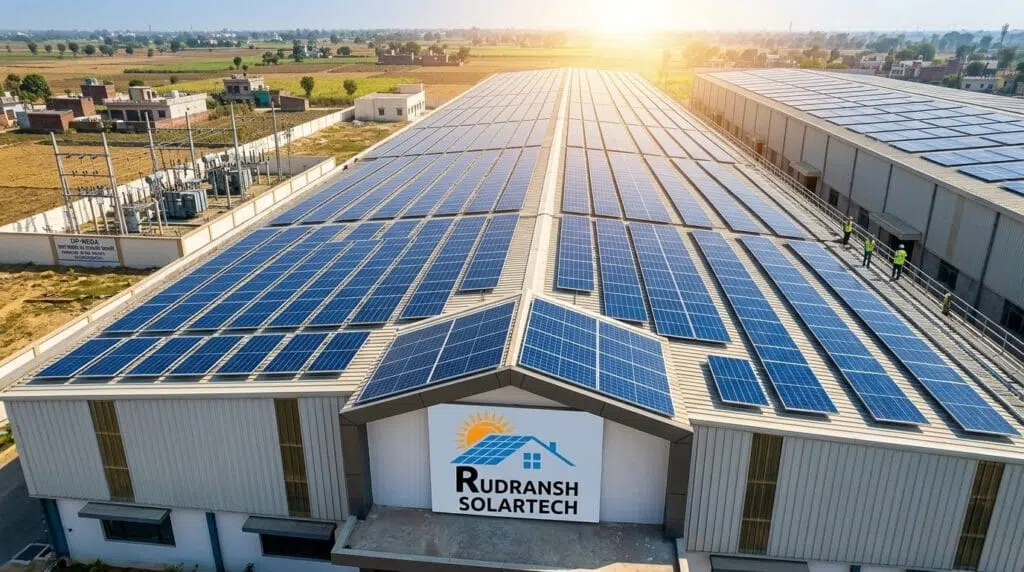
RCC roofs and metal roofs affect the overall industrial rooftop solar system price in UP because of these variations. Metal sheets (such as trapezoidal or standing seam profiles) do not require heavy concrete bases. Instead, they utilize lightweight aluminum mini-rails or standing-seam clamps, which reduces material costs. However, if an older industrial shed requires structural reinforcement to support the wind load of a new solar array, this will add to the initial investment.
3. Choosing Panels and Inverters for Industrial Applications
Component selection is a key factor in determining the performance and lifespan of your system. Industrial projects require high-efficiency components to maximize energy generation. The choice of panel and inverter technology affects both the upfront cost and long-term savings:
- N-Type TOPCon Panels: These advanced panels offer higher cell efficiency (up to 22.5%) and better performance in hot weather compared to older Mono-PERC technology. They are the preferred choice for commercial solar panel installation in Uttar Pradesh.
- Industrial String Inverters: String inverters (such as Growatt, Sungrow, or GoodWe) featuring multi-MPPT trackers are commonly used to optimize generation, particularly on roofs with varying orientations or partial shading.
- DG Synchronization: For industries utilizing backup diesel generators, integrating a synchronization controller prevents solar energy from feeding back into the generator, protecting your electrical system.
Choosing between string and central inverters will modify the industrial rooftop solar system price in UP by 5% to 10%. String inverters are popular for systems up to 500kW due to their flexibility and ease of maintenance. For megawatt-scale projects, central inverters offer a lower upfront cost but require dedicated inverter rooms and more complex cabling.
4. Tax Advantages: Accelerated Depreciation and GST Input Credit
While industrial solar plants do not qualify for residential subsidies, businesses can claim tax benefits that significantly improve the return on investment. The two main tax incentives are:
- Accelerated Depreciation (AD): Under Section 32 of the Income Tax Act, businesses can claim a 40% depreciation rate in the first year. This allows you to write off a large portion of the capital cost against your taxable business income, providing immediate tax relief.
- GST Input Tax Credit (ITC): The GST on solar power plant components is structured under a concessional rate framework. This allows you to claim the 18% GST paid on mechanical and electrical equipment as an input credit, directly reducing your tax liability.
You can write off up to 40% of the industrial rooftop solar system price in UP in the first year through depreciation, effectively reducing the net cost of the system by 25% to 35% depending on your corporate tax bracket. This tax saving, combined with monthly utility savings, makes solar a highly lucrative investment.
📊 Financial Sizing & First-Year Savings (100kWp System Example)
5. Real Savings & Generation Output in UP
Industrial solar systems generate significant savings by replacing high-cost grid power. In Uttar Pradesh, a 100kW system generates approximately 12,000 to 13,000 units of electricity per month. At an average industrial tariff of ₹8 per unit, this translates to monthly savings of ₹96,000 to ₹1,04,000, or over ₹11 lakh annually.
💰 Monthly and Lifetime Savings Profile (100kWp Industrial Plant)
This savings profile demonstrates why the initial investment is recovered so quickly. Once the payback period is complete, the system continues to generate free electricity for the remainder of its 25-year operational life, directly boosting your business’s operating margins.
6. UPPCL Net Metering and Interconnection Standards
A major factor that determines how quickly you recover the industrial rooftop solar system price in UP is the net metering policy. Uttar Pradesh Power Corporation Limited (UPPCL) allows industrial consumers to install solar systems up to 100% of their sanctioned load or contract demand under net metering guidelines.
For systems larger than 50kW, UPPCL requires the installation of a check meter alongside the main billing meter to verify export and import data. This process involves submitting single-line diagrams, load flow studies, and safety certificates to the DISCOM. Working with an experienced EPC partner like Rudransh Solartech ensures that all filings and approvals are handled correctly, preventing delays in commissioning your plant.
We work closely with local DISCOMs across Uttar Pradesh to manage these regulatory approvals. Whether your business is in the Chinhat Industrial Area or the Panki Industrial Area, we coordinate with the utility to ensure a smooth integration. Learn more about the technical process in our comprehensive guide to UPPCL net metering rules.
7. Financing and Industrial Solar Loan Programs
To help businesses fund their transition to solar, several financial institutions offer specialized loan programs. These loans are designed to cover a large portion of the upfront cost with competitive terms:
- SIDBI Green Energy Loans: The Small Industries Development Bank of India offers low-interest financing for MSMEs under programs like the “4E” scheme, with rates starting at 6% to 7% and minimal collateral requirements.
- SBI Surya Shakti Loan: State Bank of India provides financing for commercial and industrial solar projects up to 1MW, offering up to 80% funding and repayment periods of up to 10 years.
- Private NBFCs: Private lenders offer quick approval timelines and flexible terms tailored to small businesses. Explore these options in our guide to commercial solar loan options in Lucknow.
Rudransh Solartech offers competitive industrial rooftop solar system price in UP with turnkey installation, including site assessment, engineering, procurement, construction, and liaisoning. We design custom systems that fit your facility’s energy profile, maximizing both generation and financial returns.
🏭 Get a Customized Industrial Solar Quote for Your Facility
We provide a free, comprehensive site survey, shadow analysis, and financial feasibility report for your factory or warehouse in Uttar Pradesh.
📍 Serving Key Industrial Zones Across Uttar Pradesh
We offer turnkey project execution and local support across all major industrial areas in the state, including:
